By Clixtell Content Team | May 24, 2026
Estimated reading time: 8 minutes
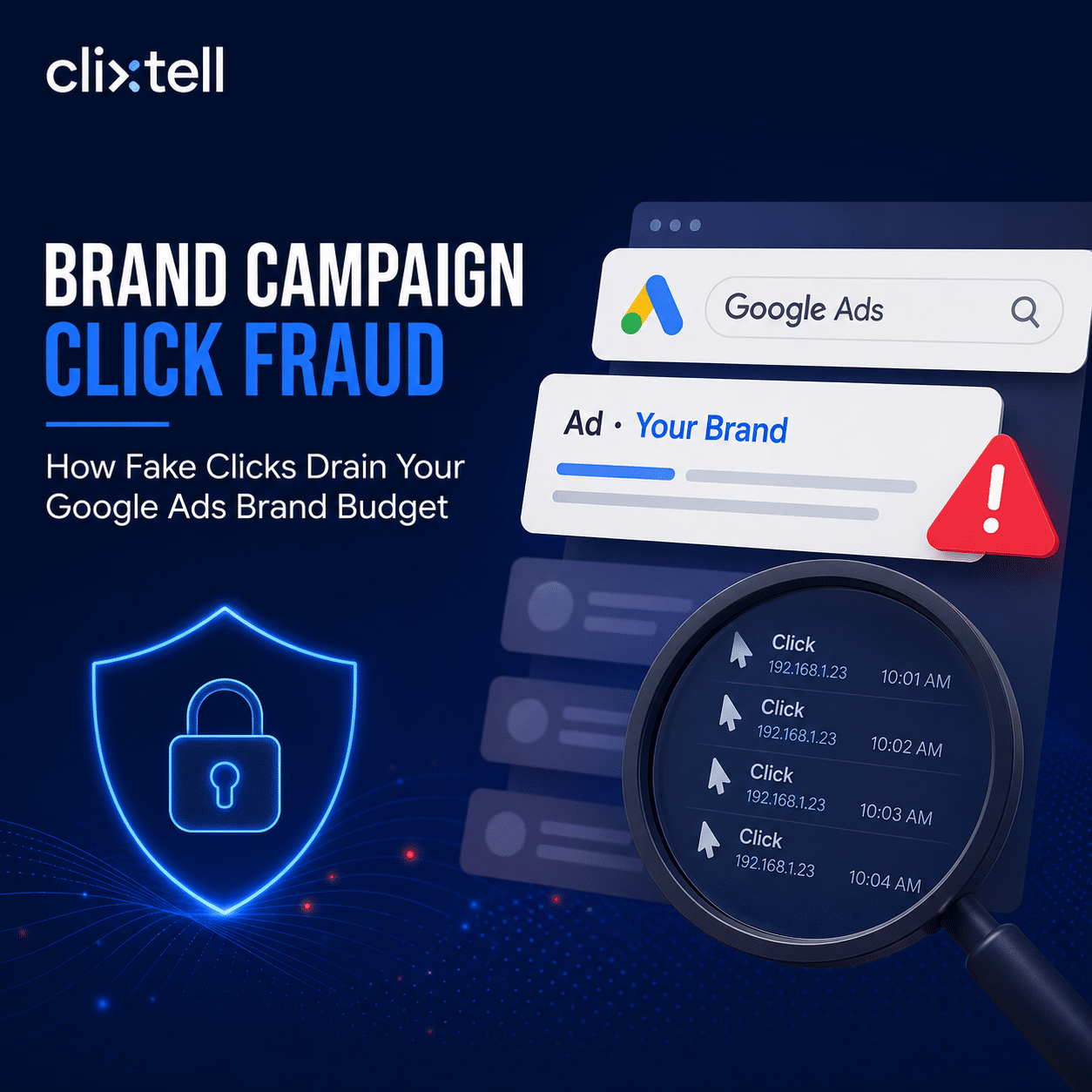
Brand Campaign Click Fraud: How to Detect and Protect Your Budget in Google Ads (2026)
Brand campaign click fraud is one of the easiest PPC problems to miss because branded traffic often looks safe at first glance.
Someone searches your company name. Your ad appears. They click because they already know you, saw your brand somewhere else, or are ready to contact you. In theory, these clicks should have strong intent, lower friction, and better conversion rates than most non-brand search traffic.
That is why many advertisers do not watch brand campaigns closely enough. They assume branded traffic is clean because it looks familiar. They see the company name inside the search terms report and treat every click as real demand.
Sometimes that assumption is correct. But in competitive markets, branded search can also attract competitors, bots, repeat users, automated scripts, VPN users, and low-quality traffic patterns that repeatedly target the same company name.
The damage is not always obvious at first. It often appears as a slow rise in branded CPC, more clicks from the same patterns, weaker lead quality, lower call quality, or budget loss on searches you already worked hard to earn.
Why brand campaigns are different from regular search campaigns
A non-brand campaign fights for discovery. A user searches for “emergency plumber near me,” “best personal injury lawyer,” or “PPC fraud protection software.” Many advertisers compete for that click. The user may compare several companies before choosing one.
A brand campaign works differently. The user searches for a specific company. The intent is narrower. The search may include your brand name, your product name, your domain, your phone number, or a branded phrase such as “Clixtell pricing” or “Clixtell login.”
That makes brand campaigns easier to read, but also easier to manipulate.
If someone wants to waste your budget, they do not need to guess your keyword strategy. Your brand name is public. Your ad is easy to find. Your landing page is predictable. Your campaign may run all day because you want to protect your own search results from competitors.
A bad actor can search your brand name, click your ad, leave quickly, and repeat the pattern later from another device, IP address, or network.
In regular search campaigns, bad traffic can hide inside broad keyword groups. In brand campaigns, the problem is more direct. You are paying for your own name, and suspicious activity can sit inside the most trusted part of the account.
Why Google Ads brand settings do not solve click fraud by themselves
Google Ads gives advertisers useful brand controls. Google’s documentation explains that brand settings for Search and Performance Max can help advertisers direct branded traffic through brand inclusions and brand exclusions.
These controls matter. They help advertisers separate brand and non-brand traffic more cleanly. They also help reduce unwanted brand overlap in automated campaign types.
But brand settings are not the same as fraud protection.
A brand inclusion can help a Search campaign focus on branded queries. It does not tell you whether every branded click came from a real customer. A brand exclusion can help keep Performance Max away from certain brand searches. It does not prove that the clicks you kept were high quality.
That is the key difference. Brand settings control where ads may appear. Google Ads click fraud protection checks who clicked, how often they clicked, what device or network pattern they used, and what they did after reaching your site.
For this reason, brand campaign click fraud should be treated as a traffic quality issue, not only a campaign structure issue.
The warning signs of brand campaign click fraud
The first warning sign is branded CPC moving up without a clear competitive reason. Brand CPC can rise for legitimate reasons. Competitors may be bidding on your name. Your ad quality may change. Auction pressure may increase.
But when branded CPC rises while lead quality falls, the account deserves a deeper review.
The second warning sign is repeat clicks from the same behavior pattern. The IP may change. The location may shift. The browser may look slightly different. But the session behavior may remain similar: short visit, no meaningful scroll, no page exploration, no form engagement, and no real buying signal.
The third warning sign is a gap between branded clicks and business outcomes. If brand clicks increase but phone calls, qualified forms, trials, demos, purchases, or login actions do not move with them, the extra traffic may not represent real demand.
This is especially important for local services, legal firms, SaaS companies, ecommerce brands, and any advertiser that depends on high-intent search.
The fourth warning sign is unusual timing. Suspicious brand clicks often appear in clusters. A competitor may click during business hours. Bots may click during low-activity hours. Repeat users may appear after pricing changes, promotions, or aggressive sales activity. The pattern matters more than one isolated click.
The fifth warning sign is weak post-click behavior from users who should already know you. A real branded visitor often has a reason to click. They may look for pricing, support, a phone number, a login page, reviews, or a specific product. A suspicious click often has no clear journey. It lands, pauses briefly, and disappears.
Why this can hurt more than normal wasted spend
Wasted budget is the obvious problem, but it is not the only one.
When fake or low-quality clicks hit a brand campaign, they can make your strongest traffic source look less reliable. Your branded CTR may stay high while conversion quality drops. Your reports may show more traffic, but your sales team may see fewer real opportunities. Your campaign may look active, but the business may not feel the same growth.
This can lead to bad decisions.
You may increase brand budget because click volume looks strong. You may raise bids to protect top position. You may assume competitors are the only issue and respond by overspending. You may change landing pages that are not the real problem. You may report brand demand as growing when part of that demand is not genuine.
Brand campaigns also feed wider account decisions. If you use automated bidding, remarketing, customer lists, or conversion-based optimization, low-quality traffic can affect more than one campaign.
A fake visitor who enters a remarketing audience may be targeted again later. A weak form submission may be counted as success. A poor session may still enter your analytics reports as a branded visit.
That is why brand campaign click fraud should be investigated early. Small leaks in brand campaigns can create larger data problems over time.
How to investigate brand campaign click fraud
Do not start by asking, “Is this click fraud?” Start by asking, “Does this branded click look like real brand demand?”
That question changes the workflow.
First, isolate brand campaigns from non-brand campaigns. Do not review all Google Ads traffic together. Separate your exact brand terms, brand plus product terms, brand plus pricing terms, and brand plus location terms. A search for your company name behaves differently from a search for your product category.
Second, compare click growth with qualified outcomes. A healthy brand campaign should usually support real business actions. If clicks rise but qualified leads, calls, demos, purchases, or login actions do not rise, check the click source patterns.
Third, review repeat activity by IP, device, network, location, and time. One repeat click is not proof of fraud. A pattern of repeat clicks with weak engagement is more important.
Fourth, use IP exclusions carefully. Google Ads IP exclusions can help reduce repeat waste from confirmed sources, but IP blocking alone is not enough. Many suspicious users rotate IPs, use mobile networks, change locations, or come through VPN and proxy services.
Fifth, review the session itself. A brand click should usually show some intent. The visitor may scroll, compare, click navigation, open pricing, submit a form, tap a phone number, or return later.
If session behavior looks empty, robotic, or repeated across many clicks, your brand campaign may be absorbing traffic that never had a real chance to convert. This is why session recordings for click fraud detection are valuable. They help you move from suspicion to proof.
How to write protection rules for brand campaigns
Brand campaigns should not always use the same rules as non-brand campaigns.
A user may click a brand ad more than once for legitimate reasons. They may compare pricing, return after speaking with a spouse or manager, look for your support page, or click again from mobile after seeing you on desktop. Blocking too aggressively can create false positives.
The better approach is to use layered rules.
Treat one repeat click differently from several repeat clicks in a short window. Treat a returning user with real engagement differently from a user with no scroll, no interaction, and no meaningful time on site. Treat a local branded click differently from a click outside your service area.
Also treat a branded click that becomes a real call or form differently from one that repeats across multiple days without any business action.
This is where brand campaign protection becomes more precise than generic fraud detection. The goal is not to block every repeated branded click. The goal is to block repeat behavior that does not match real brand intent.
A strong setup looks at frequency, device, IP, network ownership, location, time, session behavior, and conversion quality together. No single signal tells the full story. The pattern does.
How to protect brand campaigns without blocking real customers
Protecting a brand campaign requires balance. Not every repeat click is suspicious. A real customer may search your brand more than once before calling, comparing pricing, opening a login page, or returning from another device. If the rules are too aggressive, you may block real users who already know your business.
The right approach is to look for repeated behavior that does not match real brand intent. One return visit is usually normal. Several paid clicks from the same device pattern, network, location, or IP range in a short period deserve closer review, especially when the sessions show no scroll, no site navigation, no form activity, and no phone action.
Brand campaigns should be reviewed separately from non-brand campaigns. Their baseline behavior is different. Branded visitors usually arrive with stronger intent, clearer navigation patterns, and higher conversion potential. When those signals disappear, the issue is easier to detect.
A practical protection workflow should include click frequency, IP data, device signals, network patterns, location, time of day, session behavior, and lead or call quality. No single signal is enough. The pattern is what matters.
For brand campaigns, the goal is not to block every returning visitor. The goal is to stop repeated paid clicks that show no real customer intent and continue wasting budget on the company name you already own.
FAQ
What is brand campaign click fraud?
Brand campaign click fraud is suspicious or invalid clicking activity on ads that appear for your company name, product name, or branded search terms. It can come from competitors, bots, repeat users, or other low-quality sources that click without real buying intent.
Is every repeat click on a brand campaign fraud?
No. Some repeat clicks are normal. A real customer may click more than once before calling, buying, or submitting a form. The risk appears when repeat clicks show weak behavior, no real engagement, unusual timing, or repeated patterns across IPs, devices, networks, or locations.
Can Google Ads brand settings prevent click fraud?
No. Brand settings help control when ads appear for branded queries, but they do not prove that each click came from a real prospect. You still need click-level validation, behavior analysis, and repeat activity monitoring.
Should I block every IP that clicks my brand campaign more than once?
No. Blocking should be based on evidence, not one repeated click. Review the visitor behavior, location, timing, device pattern, and conversion quality before adding exclusions or automated rules.
What is the best way to protect a brand campaign?
Separate brand traffic from non-brand traffic, monitor repeat click behavior, validate engagement with session data, use IP exclusions only when evidence supports them, and apply click fraud protection rules that match how real branded visitors behave.
Final takeaway
Your brand campaign is not automatically clean because it contains your company name.
Branded clicks can be some of the most valuable clicks in your account, but they can also hide waste because advertisers trust them too much.
When brand CPC rises, clicks repeat, lead quality weakens, or branded traffic stops matching real business outcomes, you need to look past the campaign name and inspect the behavior behind the click.
Brand settings help you control branded traffic. Negative keywords help clean search terms. IP exclusions help block confirmed repeat sources. But real protection comes from connecting the full click path: search term, IP, device, network, location, session behavior, repeat activity, and conversion quality.
That is how you separate real brand demand from budget-draining noise.