By Clixtell Content Team | April 12, 2026
Estimated reading time: 9 minutes
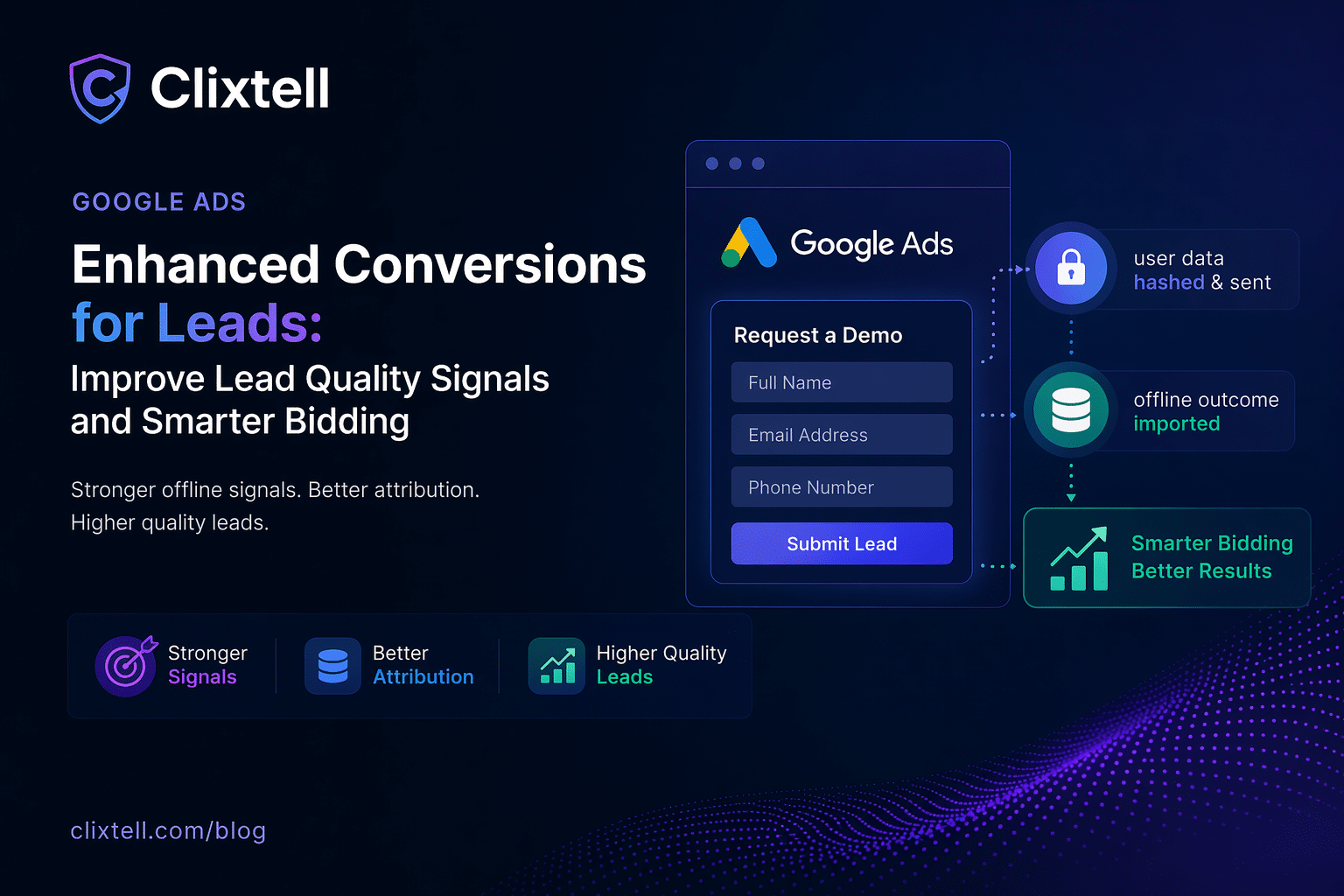
Enhanced Conversions for Leads in Google Ads: Improve Lead Quality Signals
If your campaigns generate a healthy number of form fills but your sales team keeps saying the leads are weak, the problem is often not only traffic. In many accounts, the real issue is measurement. Google Ads can only optimize around the signals it receives. When those signals are too shallow, such as counting every form submission as equal, bidding can scale the wrong users, the wrong placements, and the wrong networks. That is why enhanced conversions for leads has become an important upgrade for serious lead generation advertisers.
At a practical level, enhanced conversions for leads is Google’s upgraded version of offline conversion import Google Ads teams already use to connect ad clicks with later outcomes. It uses hashed first-party data collected from a lead form, such as an email address or phone number, and matches it to the same person when an offline lead outcome is later imported into Google Ads. That can improve measurement quality and give the platform stronger feedback about which leads actually move forward.
What Enhanced Conversions for Leads Actually Is
The simplest way to explain enhanced conversions for leads is this: it helps Google Ads connect a lead form submission to a later offline business outcome more reliably. Instead of relying only on a click ID and a later spreadsheet upload, Google can also use hashed first-party data collected during the lead process. That makes the attribution chain more durable and more accurate, especially in lead generation workflows where the real value happens after the form, not at the form.
For advertisers already using offline conversion import Google Ads processes, this is a meaningful upgrade. It gives Google Ads more ways to match offline outcomes back to ad interactions. That is useful for businesses with longer sales cycles, delayed follow-up, multiple qualification stages, or CRM workflows that sit outside the website. The goal is not to report more noise. The goal is to improve lead quality signals Google Ads can use for smarter optimization.
Why Standard Offline Conversion Import Falls Short
Traditional offline conversion import Google Ads workflows can work, but they often leave gaps. Lead generation paths are rarely clean. A user may click on one device, fill out a form later, answer a sales call days after that, and only become a qualified lead or customer after several internal steps. If your import process depends on weak identifiers, inconsistent CRM fields, or manual uploads, reporting can become incomplete.
This is where many advertisers get into trouble. The account appears to be performing because the platform sees enough top-of-funnel conversions. But the business sees a different outcome. Sales teams complain about bad leads. CPL looks fine, but close rates fall. Bidding seems efficient, but real revenue quality gets worse. This gap between platform success and business success is exactly why stronger lead quality signals Google Ads matter in lead generation.
A better setup does not simply add more tracking. It changes what the account learns from. If your system can distinguish between a raw form submission and a lead that was actually qualified, booked, or sold, the platform has a much better chance of optimizing toward value instead of volume.
How the Setup Works in Practice
The process has two main parts. First, the website captures user-provided data from the lead form and sends it in hashed form through the Google tag or Google Tag Manager. Second, when the lead moves to an offline milestone such as qualified lead, consultation booked, opportunity created, or sale, that event is imported back into Google Ads using the same identifying data. Google can then match the offline event back to the original ad interaction.
This is not just a technical upgrade. It is a signal-quality upgrade that can strengthen lead quality signals Google Ads uses for reporting and bidding. It gives the platform a better way to understand which leads mattered after the form submit. That means bidding can move away from optimizing toward every cheap conversion and closer to optimizing toward downstream outcomes that actually matter to the business.
That is also why this topic connects naturally to broader Google Ads conversion tracking work. If the signal chain is weak, Smart Bidding can learn from the wrong event. If the signal chain is stronger, bidding has a better chance of following qualified demand instead of cheap volume.
What You Need Before Setup
A strong setup starts with a working lead form and a clean thank-you flow. You also need either the Google tag or Google Tag Manager configured correctly. Beyond that, you need a CRM or another offline process that reliably stores lead status changes and can send those events back into Google Ads. Without that operational layer, the feature may be enabled, but it will not improve performance in a meaningful way.
Another important point is GCLID. Even with enhanced conversions for leads, click IDs still matter. If your process can pass GCLIDs into the CRM and preserve them through the sales cycle, that usually makes the attribution chain stronger. Hashed customer data helps, but it does not make click IDs irrelevant.
This is also why setup should involve both marketing and sales operations. Marketing may control the site and tags, but sales or revenue operations usually control CRM fields, lead statuses, and lifecycle definitions. If those teams are not aligned on what counts as a qualified lead or a real outcome, the imports will not train the account correctly.
Official Google Guidance: For the official implementation overview, matching logic, and setup options, see Google’s documentation on enhanced conversions for leads.
Common Setup Mistakes That Reduce Match Quality
The biggest implementation problems are usually operational, not strategic. Missing or incomplete user data can reduce match quality. Broken event timing on the form can stop correct capture. CRM handoff problems can disconnect the original lead from the later offline event. Formatting issues can also affect how well imported data matches back inside Google Ads.
Another common mistake is importing the wrong milestone. Some advertisers send back every internal status change because more data feels better. In reality, weak or noisy milestones can pollute optimization. You want imported actions that represent real business value, not just internal activity. If the sales team clicks a status field for administrative reasons, that should not automatically become a bidding target.
A third mistake is failing to review lead quality after the import starts. If your account already struggles with spam leads from Google Ads, stronger measurement helps, but it does not fix the entire funnel on its own. You still need clear validation rules for what counts as a useful lead.
How Better Signals Help Smart Bidding
For many advertisers, the real value is not that Google can report more conversions through offline conversion import Google Ads processes. The real value is that Google can learn from better conversion definitions. In lead generation, a form fill is often too early to represent real value. By feeding back more meaningful offline milestones, advertisers can improve the quality of the conversion signals used by Smart Bidding.
This matters even more in accounts where network and placement quality vary. If low-quality segments generate cheap form submissions, a weak measurement setup can accidentally reward them. Stronger downstream signals can help the account distinguish between volume and value. That is one reason it makes sense to connect this topic to Clixtell’s Performance Max channel reporting article and its Google Ads traffic quality audit guide.
Better signal quality also improves internal trust. When marketing reports one story and sales reports another, friction grows quickly. Cleaner offline feedback helps both teams work from the same reality. It becomes easier to identify whether the issue is traffic quality, targeting, offer quality, follow-up speed, or conversion definition.
Why Better Attribution Does Not Replace Click Fraud Protection
This topic needs a clear boundary. Enhanced conversions for leads improves attribution and bidding inputs, but it is not a click fraud protection feature. It does not block invalid clicks. It does not stop spam submissions by itself. It does not remove junk traffic from poor placements, Search Partners, or bot-driven visits. What it does is help advertisers measure lead outcomes more accurately after the click.
That distinction matters. Better measurement helps Google Ads understand which leads became real outcomes. But if low-quality traffic is still entering the account, the system may still absorb bad inputs before those outcomes are filtered out. For serious PPC teams, measurement quality and traffic quality are connected but separate tasks. Stronger attribution improves visibility. Traffic protection and account controls help reduce pollution at the source.
How to Roll It Out Safely
The safest rollout is gradual. Start by validating that the data capture is working correctly. Confirm that the right fields are being passed, the right offline milestones are being imported, and the CRM logic matches how your business defines a qualified lead. Then compare the new signal against the older one before letting it directly influence bidding.
This step matters because reporting may shift when a stronger signal becomes available. That does not always mean campaign performance changed overnight. Sometimes it means the account is simply measuring outcomes more honestly. A careful rollout gives you time to review match quality, confirm that the imported event reflects real business value, and decide when the signal is ready to play a larger role in bidding.
Who Should Prioritize This First
This upgrade matters most for three kinds of advertisers. First, businesses already using offline conversion import Google Ads workflows. Second, service businesses and B2B advertisers where real value happens after the form, not at the form. Third, accounts where reported lead volume looks healthy but sales feedback says quality is slipping. In all three cases, enhanced conversions for leads can tighten the connection between ad spend and real business outcomes.
It is especially relevant for legal, home services, healthcare, finance, education, and B2B sales teams with longer lead cycles. These businesses usually care less about raw lead volume and more about qualified conversations, booked appointments, pipeline creation, or closed revenue. A deeper signal chain gives those accounts a better chance to optimize in the right direction.
Final Take
For lead generation advertisers, the goal is not to count more conversions. It is to give Google Ads clearer signals about which leads turn into real business outcomes. When your setup connects form data, CRM updates, and offline outcomes correctly, enhanced conversions for leads can improve lead quality signals Google Ads uses for optimization and help Smart Bidding focus on what actually matters. It will not solve every performance issue on its own, but it can give your account a stronger measurement foundation for better optimization and better decisions.
If your account still relies mostly on raw form fills, now is the right time to improve the signal chain. A stronger setup will not make weak offers strong or bad traffic good, but it will help you see performance more honestly and train the platform on better outcomes. That makes it one of the most practical upgrades available to modern lead generation advertisers.
FAQ
What is enhanced conversions for leads in Google Ads?
Enhanced conversions for leads is an upgraded way to connect lead form submissions with later offline outcomes in Google Ads by using hashed first-party data for more reliable matching.
Is enhanced conversions for leads better than standard offline conversion import?
In most lead generation cases, yes. It helps Google Ads build a stronger connection between ad clicks and offline outcomes, which can improve measurement quality and support better bidding decisions.
Do I still need GCLID if I use enhanced conversions for leads?
Yes. GCLID still helps connect offline outcomes to specific ad clicks. Hashed customer data improves match quality, but it does not remove the value of preserving click IDs through the lead path.
Can enhanced conversions for leads stop click fraud or spam leads?
No. Enhanced conversions for leads improves attribution and lead quality signals Google Ads can use, but it does not block invalid clicks or stop low-quality traffic on its own.