By Clixtell Content Team | January 29, 2026
Estimated reading time: 12 to 15 minutes
Performance Max Channel Reporting: How to Spot Search Partners Waste and Protect Conversion Signals
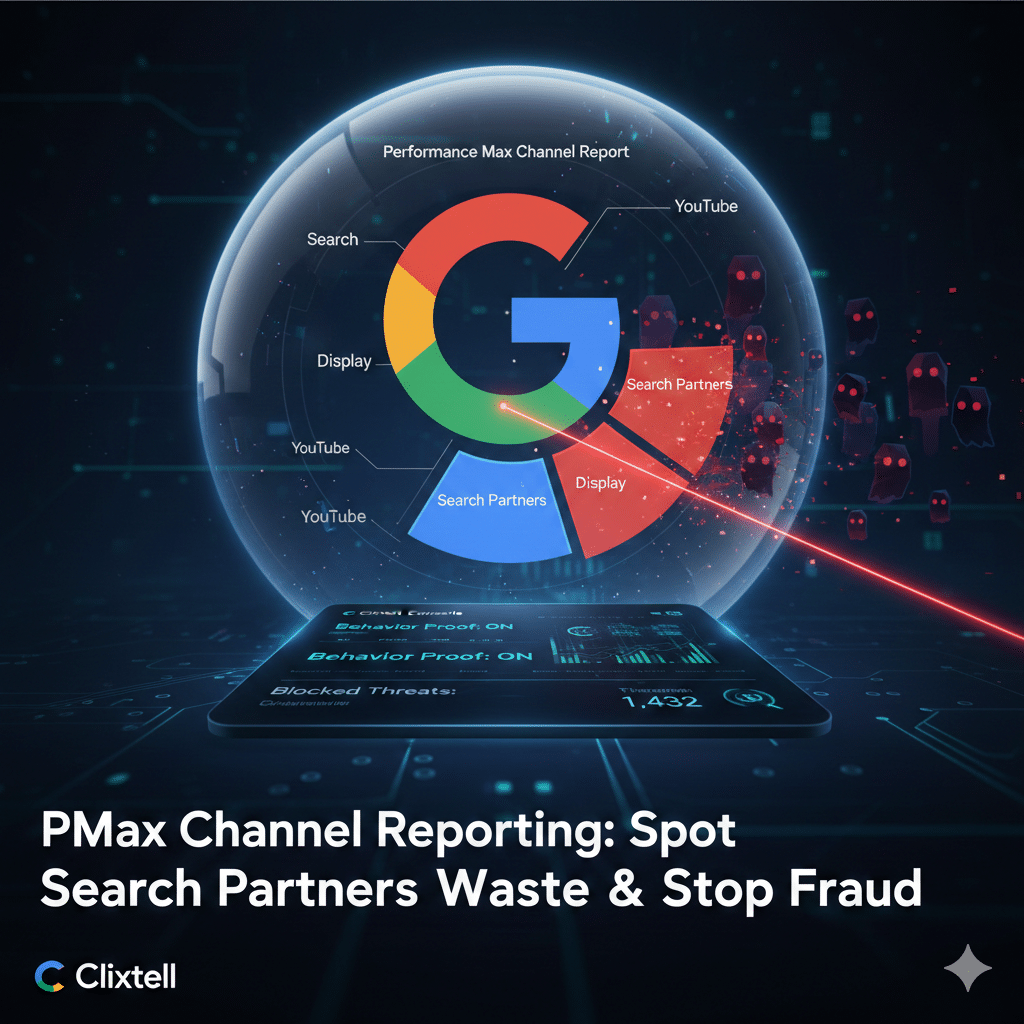
Performance Max is getting less mysterious. That matters for click fraud. For a long time, Performance Max was built to win results, not to explain itself. It could drive conversions across Search, Shopping, YouTube, Display, Discover, Gmail, and Maps. But when something felt off, you had few ways to prove where it was coming from.
That gap created a familiar problem. You would see spend and clicks rising. You would see conversion numbers that looked fine on the surface. Then you would look at lead quality, call quality, or sales quality, and it did not match the story.
Some of that mismatch is normal. Attribution is messy. User journeys are fragmented. Tracking breaks. But some of it is not normal. Some of it is low quality traffic. Some of it is invalid traffic. Some of it is click fraud hiding inside a campaign type that was designed to be broad by default.
If you care about click fraud protection, this is not just a reporting feature. It is a new way to isolate waste.
This article is about how to think about the new visibility like an investigator, not like a dashboard tourist. It is not a step by step tutorial. It is a smooth way to read the story your account is already telling you.
- Why channel visibility changes the click fraud conversation
- What the channel performance report really is
- When your numbers do not add up, start here
- PMax Investigation Framework: From Signal to Action
- The patterns that often point to waste
- Search Partners visibility and why it matters for click fraud
- If you are not using behavior proof, you are still guessing
- The most common false alarms you should rule out
- The gentle way to act without ripping your campaign apart
- Account level placement exclusions and why they matter now
Why channel visibility changes the click fraud conversation
Click fraud rarely announces itself with a clean label. It shows up as “normal” performance drift.
A little more spend. A little higher CTR. A little lower conversion rate. A little more form spam. A little more junk calls. A little more time wasted by your sales team.
The reason Performance Max made this hard is also the reason it works so well for growth. It has reach. It has automation. It expands to find conversions. That is great when the inputs are clean. It is dangerous when the inputs are polluted.
Bad traffic does not only waste budget. It teaches automation the wrong lesson. When Smart Bidding learns from low quality clicks, it can start to chase the wrong audience, the wrong placements, and the wrong “conversion” signals. Your campaign can look stable while your real pipeline gets weaker.
Channel reporting changes this in one key way. It lets you stop arguing with averages. Instead of asking “Is Performance Max good or bad?”, you can ask “Which channel is carrying the results, and which channel is carrying the risk?” That one shift is where most teams finally start to see waste that was hidden before.
What the channel performance report really is
Google describes the channel performance report as a way to understand how a Performance Max campaign delivers results across Google’s channels and inventory. It provides a campaign level summary with visuals to help you determine which channels are contributing to your goals. Official reference: Performance Max channel performance report.
Two important implications come with that wording. First, it is campaign level. You are not getting a perfect placement list for every click. You are getting a distribution map.
Second, it is tied to your conversion goals. That means you are seeing output through the lens of what the campaign thinks success is. If your conversion definition is too soft, the report can look healthy while your business is not.
So the real value of channel reporting is not that it tells you “the truth.” It tells you where to look for the truth.
When your numbers do not add up, start here
Most click fraud conversations start with emotion.
- “This traffic is junk.”
- “These leads are fake.”
- “This can’t be real.”
Channel reporting allows you to start with a calmer question. Where did the performance shift begin? If you are reading this as a marketer, you already know the moment. The week your lead quality dipped. The month your cost per lead rose. The quarter where performance became unpredictable.
When you have channel visibility, you can anchor your investigation in a simple comparison: the time window before the shift, and the time window after the shift. Now you are not guessing. You are comparing.
If the distribution changed, you have a direction. If the distribution did not change, you may be dealing with tracking, offer changes, landing page problems, or market competition, not a channel quality issue.
PMax Investigation Framework: From Signal to Action
PMax Investigation Framework: From Signal to Action
| Step | Primary Action | Tool | Key Signal |
|---|---|---|---|
| 1. Spot | Audit Channel Performance | Google Ads | Spike in Search Partner share / Spend drift |
| 2. Verify | Analyze Post-Click Behavior | Clixtell | Non-human patterns, high bounce, 0s sessions |
| 3. Isolate | Cross-Reference Leads | CRM / Sales | Mismatch between “Conversion” and Quality |
| 4. Act | Automatic Blocking & IP Exclusions | Clixtell + Google Ads | Real-time IP/Bot blocking + Account-level placement exclusions |
*Note: Clixtell combines behavioral analysis with automated IP protection to maintain traffic quality and safeguard conversion signals. These insights allow for more precise Google Ads management, refining targeting, exclusions, and account structure based on clean, validated data.
The patterns that often point to waste
Not every bad result is click fraud. But there are patterns that show up again and again when low quality traffic is getting a larger share of your spend.
- Pattern 1: One channel’s share rises while business quality drops
- Pattern 2: CTR rises, but conversion rate falls in a specific slice
- Pattern 3: Conversions rise, but post click behavior gets worse
Pattern 1 is the most common story. Conversions are steady. Lead quality drops. One channel’s share increases. Even if the channel is “allowed” by your campaign, that shift matters. You are seeing the campaign lean harder on an inventory source that may not match your intent.
Pattern 2 is where teams get misled. High CTR is not always good. In some inventories, it is easier to generate accidental clicks, incentivized clicks, or low intent clicks. When CTR is rising and conversion rate is falling, the key question is not “how do we improve CTR?” The key question is “what kind of click is this?”
Pattern 3 hurts because it looks like success. More conversions. Lower time on site. More one page sessions. More repeat patterns that do not resemble customers. This is often caused by two things: tracking inflation, or low quality “conversions” that are not real business outcomes. Channel reporting helps you narrow where the inflation is coming from.
Search Partners visibility and why it matters for click fraud
Search Partners has always been a sensitive topic for advertisers who care about traffic quality. In some accounts, Search Partners performs well. In other accounts, it becomes a quiet bucket of low intent traffic that is hard to validate, especially when your primary Search performance is strong.
Google’s update explicitly calls out that you will be able to get specific reporting on Search Partners as part of the channel reporting improvements. Official reference: Search Partners visibility in Performance Max.
This is the moment where you can stop debating “Search Partners is good” or “Search Partners is bad” as a general rule. Instead, you can treat it like a segment. If Search Partners shows meaningful volume and weaker outcomes, you have a specific suspect. If it is small and stable, it might not be your problem.
You can go one step further than reporting. If you repeatedly see weak lead quality during periods where Search Partners share rises, use conversion value rules to reduce the value of conversions that match the same low-quality patterns you can isolate (for example: specific audience segments, devices, or locations). The goal is not to overreact. The goal is to teach Smart Bidding to prioritize the conversions that correlate with real business outcomes, not the ones that look “fine” in platform reporting.
What makes Search Partners a common waste bucket
There are three reasons Search Partners can become the place where junk traffic hides. First, it is less predictable than core Google Search. Second, it can include a broader range of sites and experiences. Third, many advertisers do not monitor it closely because they could not see it clearly inside Performance Max before. Now you can.
That does not mean you should panic and shut everything down. It means you should apply the same standard you apply everywhere else: does this traffic behave like real customers?
If you are not using behavior proof, you are still guessing
Channel reporting is a great start. But it does not solve the hardest part of click fraud. Click fraud is not only a platform problem. It is a reality problem. You need to know what happened after the click.
- Did the visitor scroll?
- Did they engage?
- Did they behave like a human?
- Did they convert in a way that matches your business?
This is where a click fraud protection layer can sit inside your workflow without feeling like a hard sales pitch. If you use Clixtell to verify human behavior, you are not buying “another report.” You are adding proof.
Clixtell helps you validate traffic with signals that a standard Google Ads table does not show you in a clean way, including session recordings and patterns across IPs, devices, and networks. See: Session recordings and proof workflow.
The simplest way to explain the value is this: channel reporting tells you where to look. Behavior proof tells you what is real.
As measurement becomes more privacy-centric and third-party cookies fade, the reliable validation layer is first-party behavior proof from your own site. That is why tools like Clixtell matter more over time. They help you confirm traffic quality without relying only on platform-level processed reporting.
The most common false alarms you should rule out
If you do not rule these out, you risk blaming click fraud when the issue is actually internal.
- Tracking drift: Small changes in tags, consent settings, redirects, or forms can change conversion counts and quality.
- Offer changes: If you changed pricing, availability, shipping, or lead form friction, lead quality can change without any traffic quality issue.
- Landing page speed and mobile experience: A slow page can turn real customers into bounces, and it can make low quality traffic look worse than it is.
- CRM feedback loop changes: If your lead scoring or call handling changed, you might see “quality” drop even when traffic is stable.
Clixtell already has a conversion tracking audit style post that helps frame this without finger pointing: conversion tracking audit.
Channel reporting helps because it lets you ask a clean question: did the distribution change at the same time as the quality change? If yes, investigate the channel shift. If no, investigate your internal change log.
The gentle way to act without ripping your campaign apart
When teams suspect junk traffic, they often do one of two things. They do nothing and keep bleeding. Or they make aggressive changes and break learning. Neither is good.
A calmer approach is to tighten your environment first, then change strategy second.
- Start with your definition of success: If your conversion goal is too easy, you are inviting low quality optimization. Make sure your primary conversions represent real outcomes, not micro actions.
- Protect your remarketing pool: If low quality clicks enter your remarketing lists, they can pollute future performance across campaigns. See: click fraud remarketing.
- Block what you can prove: When you can confirm abusive IPs or patterns, IP exclusions are still a useful layer, even if they are not enough by themselves. See: IP exclusions in Google Ads.
Then add automation that blocks patterns, not one IP at a time. This is where Clixtell can be introduced without forcing it. When you rely on manual blocks alone, you are playing defense with a spreadsheet.
Click fraud groups rotate IPs, devices, and networks. A modern protection layer should recognize patterns across those signals and block in real time so the attacker stops seeing your ads. That is the practical promise behind detect invalid PMax traffic with Clixtell.
Two modern sources of this in Performance Max are worth calling out.
- Ad injection and accidental clicks: Ad injection can change what users see and can create accidental clicks that look normal in platform reporting. See: ad injection in Google Ads.
- Location mismatch and geo spoofing style behavior: If leads are supposed to come from one area and behavior suggests another, you may be looking at location distortion or low quality distribution. See: geo spoofing location mismatch.
These are not “Performance Max problems.” They are traffic quality problems that Performance Max can scale quickly if you do not catch them early.
Account level placement exclusions and why they matter now
A common frustration with broad campaign types is that exclusions can feel hard to manage.
Google’s help documentation states that account level placement exclusions apply to the Search partner network, and that this impacts campaigns that serve on Search Partners, including Performance Max. Official reference: account level placement exclusions.
That is a big operational point. It means you can manage certain exclusions in a way that scales across campaigns, instead of trying to patch one campaign at a time. For invalid traffic protection, scaling matters.
Fraud rarely hits only one campaign. It probes your account. It looks for weak spots. It shifts. So when you find a placement pattern that is clearly low quality, you want the ability to act once, not twenty times.
If you run Performance Max, you do not need perfect transparency to make better decisions. You need enough visibility to isolate risk, and enough proof to act with confidence.
Then you still need one more layer. You need to know if the clicks you are paying for behave like real customers.
That is where Clixtell fits cleanly. Not as a replacement for Google reporting, but as the proof layer that helps you confirm what is real, block what is not, and keep your bidding signals clean.
FAQ
What is the channel performance report in Performance Max?
It is a campaign level report that shows how Performance Max results are distributed across Google channels. It helps you see which channels are contributing to your conversion goals.
Why does Search Partners matter for traffic quality?
In some accounts, Search Partners is a stable source of conversions. In other accounts, it can become a segment with weaker intent. The key is to treat it like a segment and compare outcomes, not assumptions.
Does channel reporting prove click fraud?
No. It tells you where to look. To confirm low quality or invalid traffic, you still need behavior signals after the click, plus repeatable patterns over time.
Why can CTR rise while lead quality drops in Performance Max?
Higher CTR can come from inventory that produces more accidental or low intent clicks. If downstream outcomes drop at the same time, isolate the segment and validate post click behavior.
What is the fastest way to confirm low quality PMax traffic?
Compare the time window before and after performance shifted, identify the channel mix changes, and validate post click behavior. Tools that provide behavior proof can reduce guessing.
Clixtell Content Team Clixtell publishes practical PPC content focused on measurement stability, conversion accuracy, and traffic quality workflows. The goal is clear examples and repeatable checks you can apply across Google Ads accounts. View LinkedIn Profile