By Michael Green | January 21, 2026
How Fake Traffic Breaks Remarketing and How to Fix It
Remarketing should be simple.
A visitor lands on your site. They show interest. You follow up with ads. They come back and buy.
But in many accounts, remarketing turns into a slow leak. Spend goes up. Frequency goes up. CPA goes up. ROAS goes down. Teams change creatives, audiences, and budgets, and nothing really fixes it.
Often, the real problem is not the ad. It is the audience.
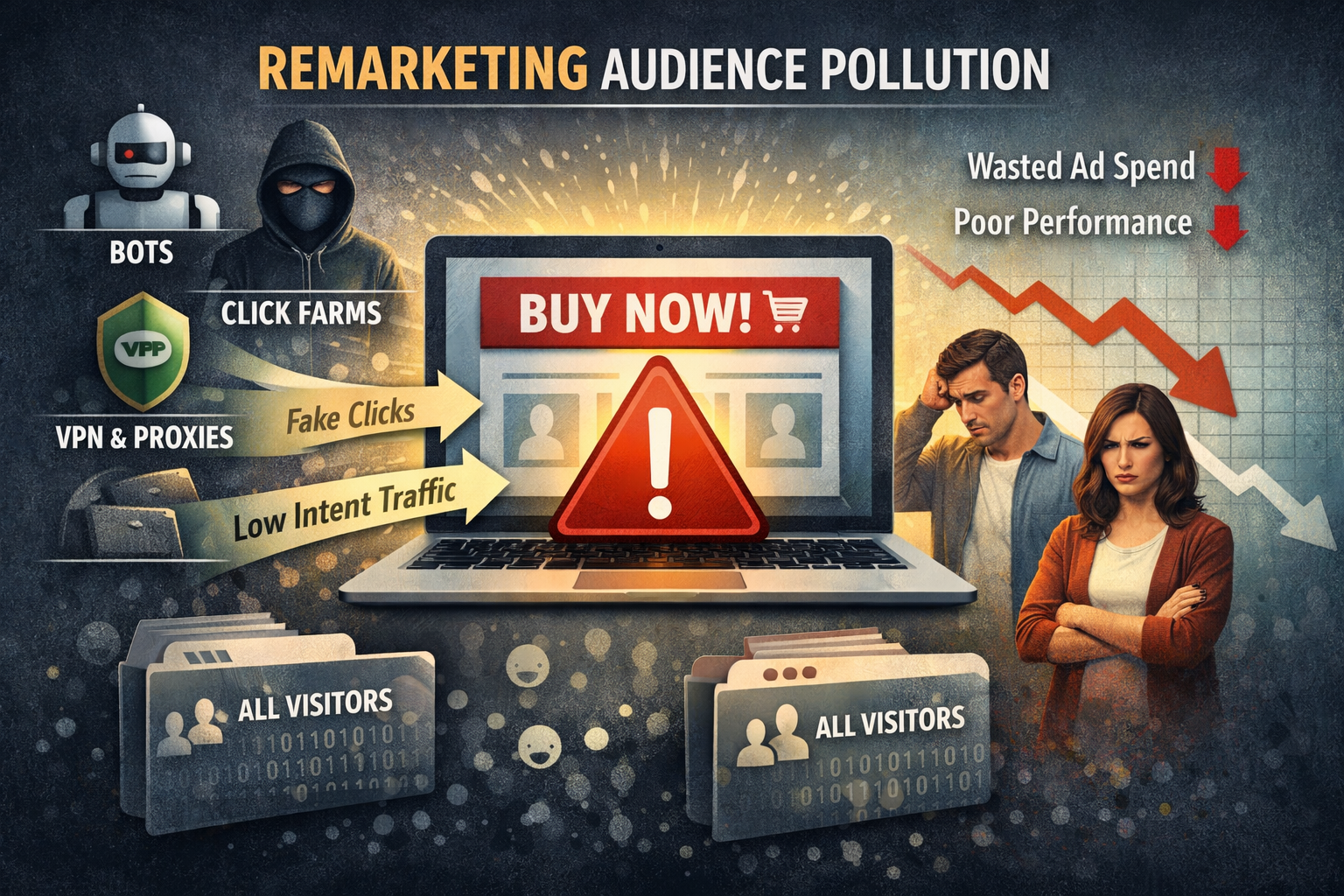
When low quality traffic enters your site, it also enters your remarketing lists. Your lists grow, but the people inside them are not real buyers. Some are bots. Some are click farm traffic. Some are VPN and proxy users. Some are real people with almost zero intent who clicked by mistake or arrived from weak placements.
That is retargeting audience pollution.
Once your audiences are polluted, you pay twice. You pay for the bad click, and then you pay again to retarget it.
Navigation
What retargeting audience pollution means
Retargeting audience pollution means your remarketing audiences are filled with visitors who will never convert.
They might look like real users in basic metrics. They can load pages, stay on the site, even click around. But they do not behave like future customers. They do not progress. They do not return with intent. They do not buy, call, or submit a real lead.
This matters because remarketing is built on 1 promise: show ads to people who already care.
If your list includes too many people who do not care, remarketing becomes a budget sink.
It also becomes a data problem. When your audiences are noisy, your targeting signals get noisy. Once the signals are noisy, the platform can spend your budget on traffic that looks active but does not produce results.
Why this happens more in 2026
Google and other ad platforms filter some invalid activity. Google explains what invalid clicks are and why advertisers are not charged for some invalid activity: Invalid clicks: Definition (Google Ads Help).
That filtering helps, but it does not solve the full problem in 2026.
A lot of harmful traffic does not look invalid at first glance. Some attackers use real devices. Some use humans. Some rotate IPs using VPN and proxy networks. Some spread activity across time so it looks normal. The goal is to blend in.
This creates a gap. Traffic can still be bad enough to waste money and pollute your remarketing lists, but not obvious enough to be filtered every time by the platform.
Where the pollution comes from
Remarketing audience pollution usually comes from 2 buckets.
Bucket 1 is fake traffic.
This includes bots, automated scripts, click farms, and traffic routed through VPNs or proxies. This traffic can create sessions that look real enough to qualify for remarketing.
If you want a simple explanation of how VPN masking shows up in fraud, this Clixtell guide is useful background: What Is a VPN? How It’s Used for Click Fraud?.
Bucket 2 is low intent traffic.
Not all harmful traffic is fraud. Some traffic is real people, but still not valuable. Think of overly broad inventory, weak placements, or campaigns optimized for cheap clicks instead of business outcomes. Those users might be curious, bored, or accidental clickers. They still enter your audiences, and then you pay again to retarget them.
Either way, you end up paying for fake traffic retargeting behavior in a practical sense. The list fills with noise, and remarketing performance degrades.
Symptoms you can spot fast
These are common symptoms. They are also the phrases people search for when something feels off.
Your remarketing CPA is increasing even though your offer did not change.
Your remarketing ROAS is dropping even though spend is stable.
Audience size grows, but conversions do not grow with it.
Frequency increases, but results stay flat.
CTR changes, but conversion rate keeps falling.
Remarketing starts behaving like cold traffic.
Here is the rule that keeps it clear. If your remarketing list gets bigger because you have more real demand, remarketing should become easier. When a bigger list makes remarketing harder, list quality is usually the problem.
The hidden damage beyond remarketing
The obvious damage is wasted remarketing spend.
The bigger damage is what polluted audiences do to your future targeting.
Noisy audiences can weaken lookalike or similar audiences built from those visitors.
Noisy audiences can confuse audience signals inside automated campaign types.
Noisy audiences can lead to budget decisions based on inflated reach numbers.
Noisy audiences can make scaling feel impossible, because scaling attracts more low quality traffic, which then makes remarketing weaker.
This is how accounts fall into a cycle. You scale spend. You attract more low quality traffic. Your audiences grow. You retarget the noise. Performance drops. Then you try to scale again to fix it.
A simple way to confirm it
You do not need complex tools to suspect retargeting audience pollution.
Start with patterns that are hard to explain in a healthy account.
Do your remarketing lists grow faster than your real demand?
Do you see sudden spikes after new campaigns, broad placements, or budget increases?
Does frequency climb while conversion rate drops?
Does reach expand but revenue does not?
Does your warm audience behave like new traffic?
If you see 2 or more at the same time, treat audience pollution as a likely cause.
Google explains that data segments are collections of visitors and that you can set rules and membership duration. This is the core lever you control: How your data segments work (Google Ads Help).
How to fix it without making it complicated
The fix is 1 shift. Stop building audiences from visits. Build audiences from intent.
This shift creates clean remarketing audiences because intent is harder to fake, and it filters low value visitors naturally.
First, stop treating all visitors as your main audience. You do not need to delete it. Just stop letting it drive most remarketing spend.
Second, build a high intent core audience. This audience should be smaller because it is based on meaningful actions. Small is good.
High intent actions can include pricing visits, product page plus a second key page, cart or checkout steps, a service page visit followed by a click to contact, or a lead form start paired with real on page engagement.
Third, keep a second audience for soft intent, but keep it controlled. Lower bids. Lower budgets. Shorter membership windows.
Fourth, treat duration as hygiene. Longer windows keep low intent visitors inside your system for longer. Shorter windows remove noise faster, especially for broad audiences.
Fifth, fix lookalikes at the source. If you seed lookalikes from visitors, you scale noise. Seed only from outcomes like purchasers, qualified leads, meaningful calls, and customers.
How Clixtell helps in 2026
Many advertisers think invalid clicks is only about billing. In 2026, the bigger damage is downstream.
Even when some invalid activity is filtered in platform, enough harmful traffic can still reach your site. That traffic can enter your remarketing lists and create click fraud remarketing waste.
Clixtell helps by detecting and blocking suspicious traffic so fewer bad clicks become sessions, and fewer sessions become audience members. Over time, this reduces retargeting audience pollution and helps remarketing performance stabilize.
Start here: How Clixtell works.
To validate patterns with evidence, session recordings can help: Detect click fraud in real time with session recordings.
2 short examples
Example 1: Ecommerce
An ecommerce store runs broad prospecting and sees traffic growth. Their all visitors list grows fast. Remarketing spend grows with it, but purchases do not.
They rebuild audiences around intent and shorten broad windows. The list gets smaller but stronger. ROAS improves because ads stop chasing low intent sessions.
Example 2: Lead generation
A B2B company sees more site visits but fewer qualified leads. Their remarketing list grows, but sales calls do not.
They rebuild remarketing around high intent pages, shorten broad windows, and seed lookalikes from qualified outcomes only. The list shrinks, but lead quality improves.
FAQ
What is retargeting audience pollution?
Retargeting audience pollution happens when remarketing lists fill up with bots, fraud traffic, VPN users, and low intent visitors. Your lists grow, but performance drops because you keep retargeting people who will not convert.
How do I clean polluted remarketing audiences?
Stop using all visitors as your main list. Build a high intent audience based on meaningful actions, shorten broad windows, keep soft intent controlled, and seed lookalikes only from qualified outcomes.
Can click fraud protection improve remarketing ROAS?
Yes. When you block suspicious clicks before they reach your site, you keep conversion data and remarketing audiences cleaner. Cleaner audiences usually lead to better efficiency over time.