By Clixtell Content Team | March 30, 2026
Estimated reading time: 8 to 10 minutes
TikTok Ads Click Fraud: What Every PPC Advertiser Must Know in 2026
TikTok has grown from a short-video entertainment app into one of the most competitive paid advertising platforms in the world. With nearly 2 billion active users and an algorithm built for maximum attention, brands are allocating serious budget to TikTok campaigns. The results can be strong. But beneath the impressive reach numbers and engagement metrics, there is a problem that most advertisers have not confronted directly.
TikTok Ads click fraud is real, it is growing fast, and it hits harder on this platform than on almost any other major advertising network. If you are spending money on TikTok campaigns and have not taken a serious look at your traffic quality, this article will show you exactly what is at stake and what you can do about it.
What Is TikTok Ads Click Fraud?
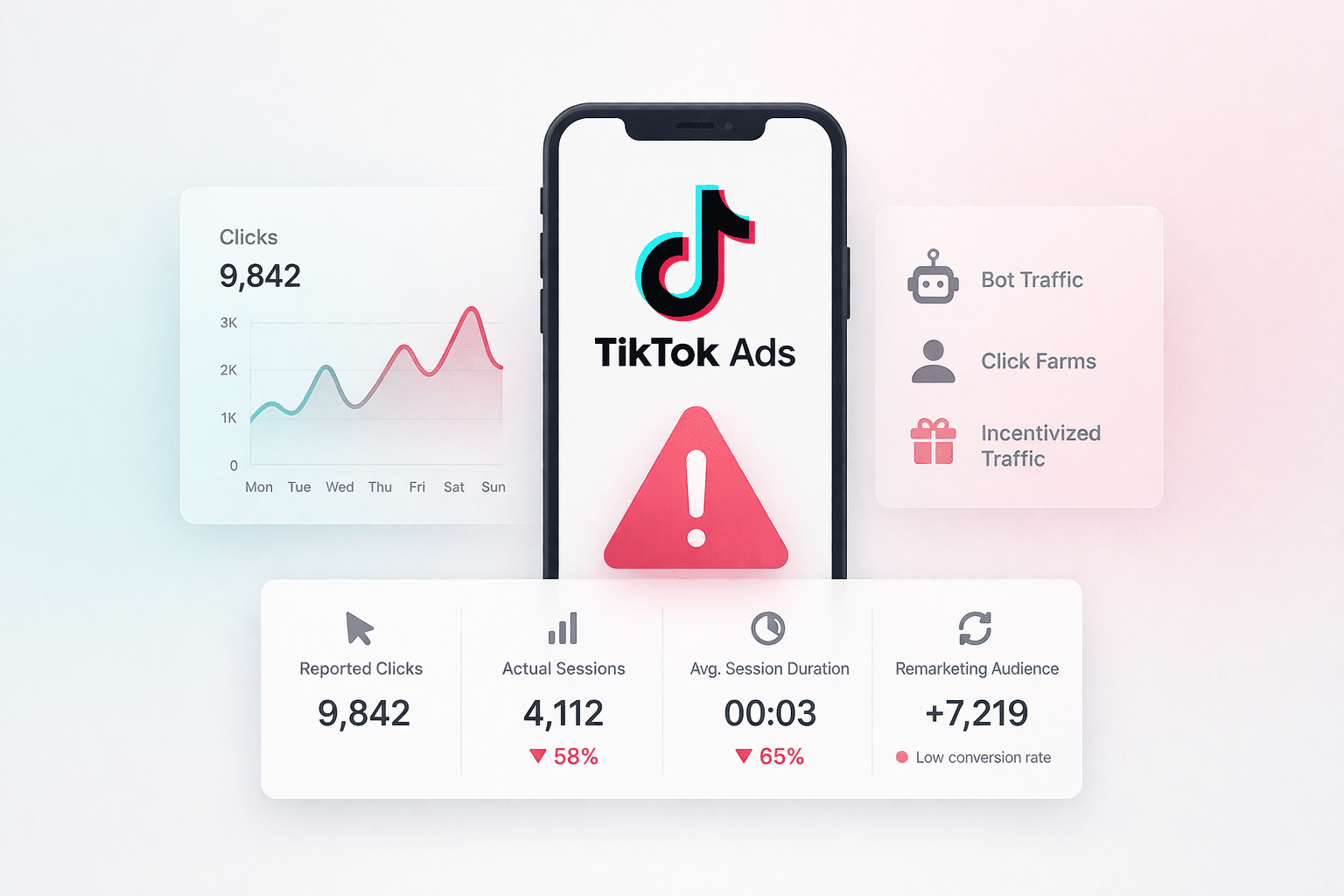
Click fraud is any ad interaction that does not come from a real human user with genuine intent to engage. This includes bot activity, click farms, incentivized traffic operations, and attribution manipulation tactics designed to make campaign metrics look better than they actually are.
On TikTok, invalid traffic takes several distinct forms.
Bot traffic refers to automated scripts that interact with ads at scale. These programs simulate taps, video views, and even app installs in ways that create the illusion of real engagement. Because the signals they generate can look similar to legitimate mobile traffic, platform-level detection systems often struggle to catch them before your budget is spent.
Click farm activity involves organized operations where people are paid to manually interact with ads. Because real humans perform these clicks, they bypass many automated filters. The clicks are real. The intent is not.
Incentivized traffic comes from users inside third-party apps who click on ads in exchange for in-app rewards. These users have no interest in your product. They click because they are being paid a fraction of a cent to do so.
Attribution fraud is more technically complex. Fraudsters intercept legitimate user actions and falsely claim conversion credit, making campaigns appear to perform when they are not. This type of fraud directly corrupts the signals your bidding algorithm uses to optimize spend.
Why TikTok Has the Highest Invalid Traffic Rate of Any Major Platform
This is not a hypothesis. Industry analysis covering more than 2.7 billion paid ad clicks across major platforms found that TikTok recorded the highest average invalid traffic rate of any network in the dataset, at 24.2%. That means nearly one in four TikTok ad clicks showed signs of non-human or invalid activity.
| Ad Platform | Average Invalid Traffic Rate (2026) | Primary Fraud Type |
|---|---|---|
| TikTok | 24.2% | Bot traffic, click farms, Pangle network |
| 19.88% | Bot traffic, incentivized clicks | |
| Meta (Facebook/Instagram) | 8.2% | Bot traffic, fake accounts |
| Google Ads | 20.4% | Competitor clicks, bots |
TikTok sits at the top of this list for structural reasons, not just coincidence.
Google and Meta have spent more than a decade under intense regulatory and legal pressure related to invalid traffic. That pressure forced major investment in fraud detection infrastructure over time. TikTok’s ad platform is newer, its anti-fraud systems are less mature, and the platform has not yet faced the same long-term accountability cycle.
Beyond platform maturity, TikTok’s ad delivery environment has specific vulnerabilities that fraudsters actively exploit.
The platform runs almost entirely on mobile. Automated click activity blends more easily into mobile traffic patterns than desktop traffic, where behavioral signals are easier to analyze. Mobile-only delivery gives fraud operations more cover.
TikTok also extends its ad inventory beyond its own app through the Pangle network, a collection of thousands of third-party partner apps. Quality control across that network varies significantly. Low-quality apps within Pangle are prime environments for fraudulent engagement, and most advertisers have no visibility into which apps their budget is actually being served in.
Finally, campaign objectives that prioritize volume invite the lowest-quality traffic. Traffic-objective campaigns instruct the algorithm to find the cheapest clicks possible. Cheap clicks and invalid traffic often come from the same sources.
What TikTok Click Fraud Looks Like Inside Your Account
The numbers inside TikTok Ads Manager will look fine. That is the central problem. Invalid traffic is designed to avoid detection at the platform level, so you will not receive an alert telling you that a quarter of your clicks were not real. Instead, you will see a set of symptoms that are easy to misattribute to creative performance or targeting problems.
High Click-to-Session Discrepancy
A large gap between platform-reported clicks and actual sessions in your analytics is one of the clearest signals available. You are paying for thousands of clicks, but when you check your website data, a fraction of those visitors actually appear. That discrepancy does not happen by accident.
High CTR with 0 Conversions
High click-through rates with 0 conversions is another consistent pattern. Your creative appears to be working based on CTR. Nothing converts. Fake clicks generate fake CTR. They do not generate revenue.
Extremely Short Session Durations
Sessions that show near-0 time on site point directly to invalid activity. Bots and incentivized clickers do not browse your product pages. They land and leave within seconds. If your analytics shows a pattern of extremely short sessions from TikTok traffic, that is worth investigating before spending more.
Sudden Traffic Spikes with No Results
A sharp increase in clicks on a specific day that generates 0 business outcomes typically indicates coordinated invalid activity rather than a genuine surge in interest. Organic interest spikes tend to produce at least some downstream engagement. Fraud spikes produce nothing.
Polluted Remarketing Audiences
Polluted remarketing audiences are a downstream consequence that many advertisers miss entirely. When invalid traffic lands on your site, those visitors are added to your retargeting lists. You then spend additional budget following up with bots and click farm workers. Your remarketing campaign looks like it is underperforming. In reality, the audience itself was compromised at the source.
Where TikTok’s Own Protection Falls Short
TikTok is not ignoring the problem. The platform has partnered with DoubleVerify and Integral Ad Science for third-party traffic verification, and its Pangle network includes automated filters designed to identify and remove malicious app placements. TikTok has also achieved TAG certification, which recognizes the platform’s fraud detection and removal processes.
These are real steps. But they have limits.
Platform-level protection is reactive. It identifies and filters known patterns of invalid traffic. Sophisticated invalid traffic, which includes residential IP bots, human-operated click farms, and coordinated manipulation that mimics genuine behavior, presents a much harder challenge for systems that operate from inside the platform.
There is also a structural tension at the heart of platform self-policing. Advertising platforms earn revenue from every click, valid or not. That dynamic does not mean platforms are deliberately ignoring fraud, but it does mean that independent analysis consistently finds invalid traffic rates significantly higher than what platforms report themselves.
This is not a TikTok-specific issue. It is an industry-wide reality. No platform’s native protection is enough on its own, and the platforms with the longest history of advertiser scrutiny have simply had more time to close gaps that TikTok is still working through.
How TikTok Fraud Differs from Google and Meta
If you already manage click fraud on Google Ads, it is tempting to assume the same knowledge applies to TikTok. Some of it does. Much of it does not.
On Google Search, fraud is primarily competitor-driven. Malicious actors click your ads repeatedly to drain your daily budget and reduce your ad exposure. The primary victims are advertisers. On TikTok, the dominant fraud types are publisher-side and bot-driven. The primary beneficiaries are click farms and fraudulent app publishers within the Pangle network who profit from inflated engagement metrics. The motivation and mechanics are different.
TikTok’s video format also introduces a fraud category that does not exist in search advertising: view fraud. Fraudsters can artificially inflate video completion rates and watch-time signals. This teaches TikTok’s algorithm that your ad is performing exceptionally well, causing it to allocate more budget toward the same low-quality sources. The algorithm is not failing. It is being deliberately manipulated using your own budget as the mechanism.
Facebook and Google Ads click fraud each have their own distinct patterns. TikTok adds a third layer of complexity that deserves dedicated attention from any PPC team running multi-platform campaigns.
A Practical Protection Framework for TikTok Advertisers
Audit Your Click-to-Session Discrepancy
Pull your TikTok click totals from Ads Manager and compare them against actual sessions recorded in your analytics platform. A discrepancy above 20% is a serious signal that warrants action before you add more budget.
Review Your Placement Settings
Decide whether Pangle placements align with your campaign goals. If you are running direct-response campaigns focused on measurable conversions, restricting delivery to TikTok’s core inventory and monitoring performance closely is a reasonable starting point.
Match Your Campaign Objective to Your Real Goal
Traffic-objective campaigns attract the cheapest clicks and the lowest-quality traffic sources. Conversion-focused and lead generation objectives give the algorithm better signal about what a qualified outcome looks like.
Monitor Your Remarketing Audiences Independently
If your retargeting lists are growing quickly but retargeting campaigns are not converting, invalid traffic may have entered your audiences. Audit the quality of your audience sources before continuing to spend against them.
Implement Independent Third-Party Traffic Monitoring
Platform-reported data reflects what the platform wants you to see. Independent tools that analyze your incoming traffic separately from what TikTok reports give you a view the platform itself cannot provide and has no incentive to give you proactively.
Cross-Reference Your CRM Data
TikTok may report leads. Your CRM will tell you whether those leads were real contacts with genuine interest. A consistent gap between platform-reported conversions and qualified leads in your CRM is a PPC fraud signal, not a creative or targeting failure.
The Real Cost of Doing Nothing
TikTok’s growth as an advertising platform is not slowing down. More brands are entering the space and competition for attention is intensifying. In that environment, wasted spend on invalid traffic is not just a line-item problem. It is a direct competitive disadvantage that compounds over time.
If a competitor is monitoring and filtering invalid traffic from their TikTok campaigns and you are not, they are getting more real customers per dollar spent. Over a quarter, that gap widens in ways that have nothing to do with who has better creative or smarter targeting.
The encouraging reality is that TikTok Ads click fraud is detectable, measurable, and manageable. It requires the right visibility tools, a willingness to question platform-reported numbers, and a systematic approach to traffic quality that does not stop at what the dashboard shows you.
The advertisers who protect their budget today are the ones building campaigns on reliable data, real audience signals, and conversion inputs that actually reflect genuine customer behavior. That foundation changes everything about how your campaigns scale.
Running ads across multiple platforms? Explore our traffic quality resources to protect your spend across every channel.
FAQ
What is TikTok Ads click fraud?
- It encompasses bot traffic, click farms, incentivized clicks, and attribution fraud
- All interactions that inflate ad metrics without delivering real business value
- Unlike Google fraud which is competitor-driven, TikTok fraud is mostly publisher-side and bot-driven
Why does TikTok have the highest invalid traffic rate among major ad platforms?
- TikTok recorded a 24.2% average IVT rate — the highest of any major ad network
- Mobile-only delivery gives bots and click farms more cover than desktop environments
- The Pangle partner network extends ad inventory to thousands of third-party apps with uneven quality control
How can I tell if my TikTok campaigns have click fraud?
- Large gap between platform-reported clicks and actual sessions in your analytics
- High CTR with 0 conversions despite healthy creative metrics
- Near-0 session durations from TikTok traffic
- Remarketing audiences that consistently fail to convert
Does TikTok protect advertisers from click fraud on its own?
- TikTok partners with DoubleVerify and IAS and holds TAG certification
- Platform-level protection is reactive by design — it filters known patterns, not sophisticated fraud
- Independent monitoring consistently finds higher IVT rates than what platforms self-report