By Clixtell Content Team | March 5, 2026
Estimated reading time: 10 minutes
2026 Ad Fraud Statistics: The $100B+ Risk to Google, Meta, and Bing Ads
If your 2026 ad campaigns feel like they’re running in place despite “perfect” platform metrics, you aren’t imagining it. The industry has hit a tipping point. We’ve moved past the era of simple bot scripts; today, we are facing Agentic AI—autonomous entities that don’t just click, but mimic human browsing patterns, scrolling, and even “hesitation” with frightening accuracy.
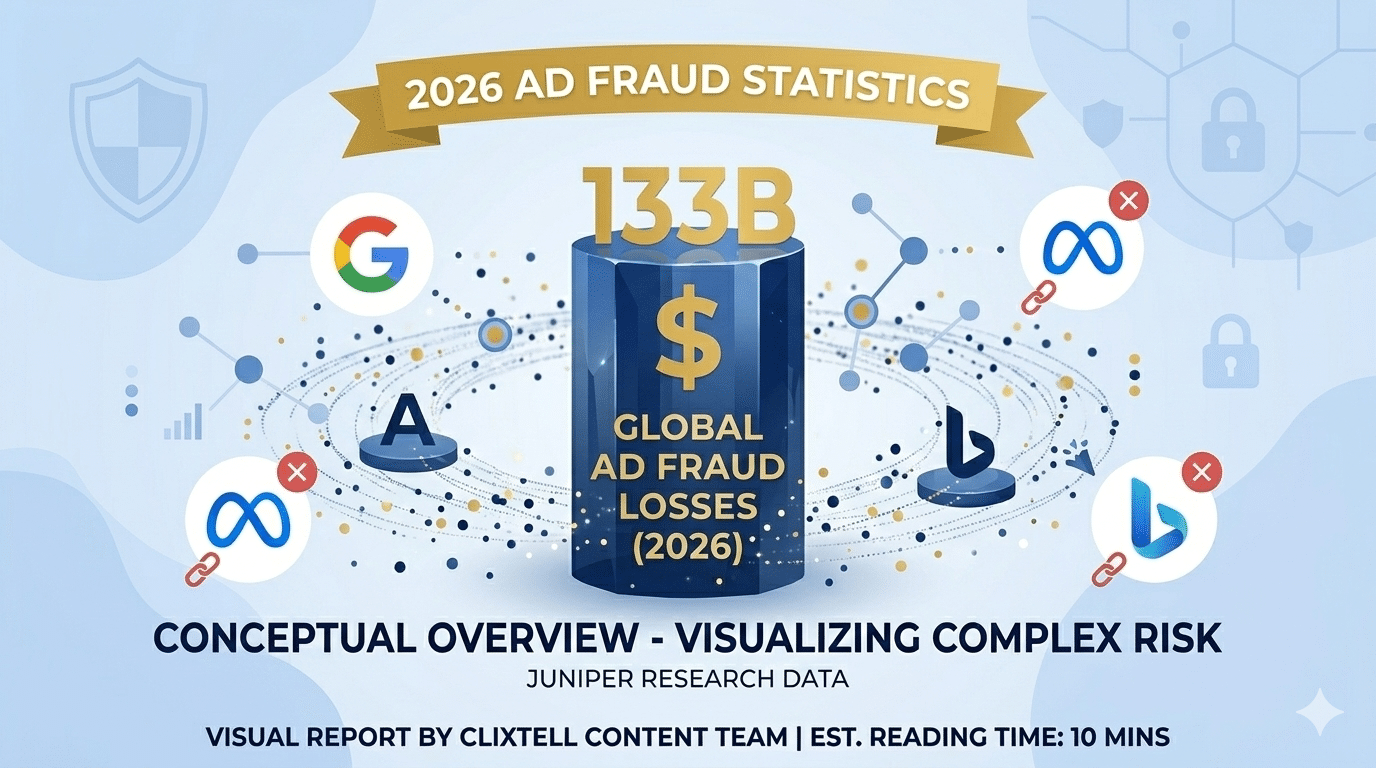
At Clixtell, we’re seeing a widening gap between what Google and Meta report as “valid” and what actually results in a sale. With global fraud losses projected to hit $100 billion this year according to Juniper Research, the real danger isn’t just the stolen click—it’s the “garbage data” that poisons your Smart Bidding algorithms and trains your account to waste money faster.
2026 Core Industry Benchmarks
To provide a source of truth for advertisers, we look at neutral data synthesized from industry oversight bodies. The current consensus is that roughly 20.6% of all programmatic traffic is invalid.
2026 Ad Fraud Key Metrics
| Metric | 2026 Neutral Stat | Primary Source |
|---|---|---|
| Global Fraud Losses | $100.2 Billion | Juniper Research |
| Average IVT Rate | 20.64% | Fraudlogix Dataset |
| “Unprotected” Fraud Gap | 15x Higher | IAS Media Quality Report |
| Programmatic Waste | 24.5% of Spend | ANA Transparency Study |
Platform Deep-Dive: Google, Meta, and Bing
In 2026, the “Big Three” have consolidated power through AI, but their automated “Black Box” solutions have created new ground for fraudulent activity.
Google Ads: The Performance Max Crisis
Google’s Performance Max (PMax) is the standard in 2026, yet its lack of transparency often hides waste on “Made-for-Advertising” (MFA) sites. Neutral studies show that MFA websites represent 21% of programmatic impressions. To combat this, you must analyze Performance Max channel reporting to isolate Search Partner waste.
Microsoft (Bing) Ads: Search Partner Vulnerabilities
Bing’s Search Partner Network remains a primary vector for fraud. It is essential to follow a traffic quality audit triage to identify “domain spoofing,” which costs Bing advertisers billions annually.
The Rise of Agentic AI and M2M Fraud
The defining characteristic of 2026 fraud is autonomy. Agentic AI is now capable of human mimicry: simulating mouse movement, “reading time,” and page hesitation.
More dangerously, these bots engage in “Lead Poisoning,” filling out forms with stolen PII to trick Smart Bidding algorithms into finding more fake leads. This is why click fraud protection in the AI era requires real-time behavioral validation rather than simple IP blocking.
High-Risk Industries & Click Farm Impact
Verticals with high Cost-Per-Click (CPC) remain the primary targets for organized click farms. In 2026, Finance, Home Services, Legal, and Real Estate report IVT rates as high as 42%.
In a 2026 London-based case study for a moving company, Clixtell identified that 68% of fraudulent activity was attributed to human click farms. Because these are real people using real devices, they bypass most standard bot detectors. Only behavioral intelligence can flag the lack of real decision-making intent.
Behavioral Intelligence: Beyond the Click
In 2026, traditional metrics like CTR and Bounce Rate are easily spoofed. To find the truth, data must be verified through session recordings.
Session replays act as a surveillance system, revealing unnatural movement patterns. This visual evidence is critical for building a refund evidence pack to hold platforms accountable for invalid charges.
Why Clixtell is the Best Solution for 2026
The hard truth of 2026 is that you cannot expect ad platforms to effectively audit themselves—it’s a clear conflict of interest. This is why we built Clixtell to serve as an independent source of truth. We don’t just look at IP addresses; we look at human intent.
While Google’s “black box” automation might tell you a click was valid, Clixtell’s behavioral fingerprinting reveals the reality. If a “user” exhibits pixel-perfect movements or skips the natural decision-making process, our system flags it instantly. By filtering this traffic before it reaches your CRM, our users aren’t just saving 20% of their budget—they are ensuring their Smart Bidding is trained only on real, high-intent human customers. In this landscape, data integrity isn’t a luxury; it’s your only competitive advantage.
Technical Standard: For the official 2026 industry definitions of Sophisticated Invalid Traffic (SIVT), you can refer to the Media Rating Council (MRC) Standards. Clixtell’s detection logic is built to align with these global transparency requirements.
FAQ
How much money will be lost to ad fraud in 2026?
Neutral research from Juniper Research projects global ad fraud losses to reach $100 billion + in 2026 and 133 billions by 2028, driven largely by AI-powered botnets and autonomous agents.
What is “Agentic AI” fraud?
Agentic AI fraud refers to autonomous bots that mimic human behavior—such as scrolling, pausing, and form-filling—to bypass traditional detection filters and pollute conversion data.
Why is Performance Max vulnerable to fraud?
PMax is a “black box” system that often serves ads on Made-for-Advertising (MFA) sites and Search Partner networks where invalid traffic rates are significantly higher than on the main search results page.
Is blocking IPs enough to stop modern fraud?
No. With the rise of residential proxies and mobile botnets, IP blocking is only 50% of the solution. You need behavioral fingerprinting and session-level validation to stop sophisticated 2026 threats.